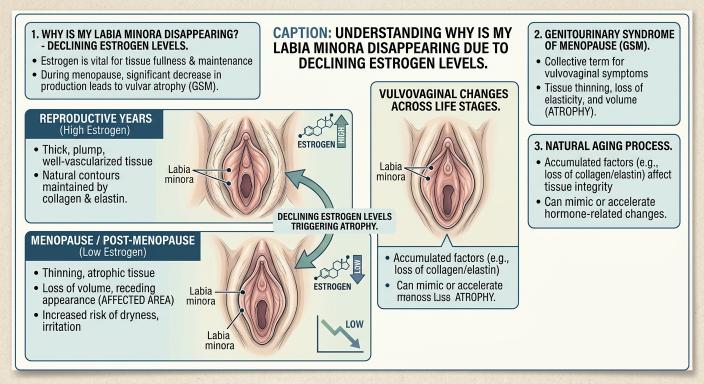
If you have noticed that your inner labia seem smaller, less visible, or as though they are gradually disappearing, it can be unsettling. The question “why is my labia minora disappearing?” often comes from someone who has noticed a genuine change in appearance and wants to know whether it is a normal part of aging or a sign of a medical problem.
There’s no right – or wrong – look when it comes to labia minora. Labia sizes, colors, and symmetry, in the same way as the shapes, vary a significant number of amounts between folks, and also can transform for the length of time life is experienced, using American University of OB GYN (ACOG) specifying they’ll end up longer compared to labia majora, however there’sAbsolutely nothing in connection to atypical from them being shorter, also.
When viewed like a normal occurrence then there is absolutely nothing to fear However when compared with a freshly advanced narrowing with labial tissue It needs to give reason For Concern especially if there IS burning, burning, aching pain, burning and tears or alterations in the color and texture of the tissue Or trouble with sex OR with urination.
Hormonal modifications that happen near to menopause create scar tissue as well as anatomical distortions within the vagina – a couple of the factors could exist.
As for example skin, such as lichens, some of this sort can cause inflammation scar as well as deformations. Past surgeries or other damage have brought about a change in labial appearance too.
Just how to tell a typical form of an adjustment?
Read More.
First, What Exactly Are the Labia Minora?
The labia minora are the inner folds that are a part of the vulva. They are tucked inside the labia majora and envelop the entrance to the vagina and urethra. Above the labia minora is the clitoris.
Labia minora are dramatically different in appearance from person to person.
Your labia minora might drape over your outer labia or could be completely hidden under your labia majora. Your labia majora could be longer than your inner labia or one might be significantly longer than the other. Even the color can differ.
And those differences are important because images of what vulvas look like-whether they’re from photos, the porn industry, cosmetic-surgery advertisements, or are heavily edited-can lead us to believe that there’s a “typical” appearance of a vulva. ACOG specifically states that size, shape, and color all vary greatly and are influenced by age,puberty, childbirth and hormones.
So even though having very small or almost undetectable labia minora is very common, it isn’t inherently abnormal.
The question you should ask yourself is whether your tissue has changed from where it started.
Why Is My Labia Minora Disappearing?
1. Menopause Can Make the Labia Smaller
One of the most important explanations is declining estrogen during perimenopause and menopause.
As estrogen levels fall, tissues of the vulva and vagina can become thinner, drier and less elastic. ACOG states that during menopause, the clitoris, labia and vaginal opening may become smaller.
These changes are part of what is now commonly described as genitourinary syndrome of menopause (GSM).
The change is not necessarily limited to the vaginal canal. The vulvar tissues can also become less full and more delicate.
Someone going through menopause may therefore notice that the labia minora look less prominent than they did earlier in adulthood.
Other symptoms can provide clues that hormonal changes are involved. These may include vaginal dryness, burning, itching, pain during sex, urinary symptoms or increased susceptibility to urinary tract infections.
If the change is gradual and occurs alongside other menopausal symptoms, declining estrogen is one reasonable possibility.
2. Genitourinary Syndrome of Menopause Can Change Vulvar Appearance
GS Mis deserved separate attention, because it covers more than vaginal dryness.
Reduced estrogen, can have effects on tissues of the vagina, urethra, and bladder. They can begin to thin out, lose elasticity and even have changes in lubrication and blood flow.
Cleveland clinic defines vaginal atrophy (now largely a part of GSM) as “tissue changes of the vulva and vagina that are related to decreased estrogen levels”. Symptoms may range from dryness to burning, itching, pain during intercourse and various urinary symptoms.
This is not to say, every woman who is experiencing thinner-looking labia is experiencing GSM. If the visual change came on about menopause, then this along with vaginal dryness or irritation, is certainly worth bringing up with your gynecologist. If you are experiencing ongoing discomfort alongside visual changes, learning to identify common genitourinary syndrome of menopause symptoms can help you decide when it’s time to speak with a specialist.
Treatments will vary on the signs and symptoms as well as a women’s own health condition. Treatment may include vaginal moisturizers and lubricants, some may even use local estrogen treatment prescribed from their doctor. According to ACOG, ‘local estrogen treatment effectively and safely restores vaginal structure and function and alleviates symptoms,’ dryness, and irritation.
3. Lichen Sclerosus Can Cause Shrinking and Scarring
A much more important reason to seek examination is lichen sclerosus, an inflammatory skin disease which is chronic and often occurs around the vulva. Lichen sclerosus can manifest as itching, burning and alteration of texture and structure of vulvar skin. Over time, chronic inflammation and resultant scar tissue result in deviation from the normal anatomy of the area.
In many cases (sometimes to the point of disappearing without the trace of original labial forms due to resorption of tissue and scarring and loss of anatomical shape/definition), the labia minora (inner most lips) are said to reduce, to become almost undetectable or simply non existent to observation; DermNet stated that chronic inflammatory diseases, like lichen sclerosus, may cause the labia minora to shrink or entirely vanish.
This is very different from simply having naturally small labia.
Possible warning signs include:
- Persistent or intense vulvar itching
- White or pale patches of skin
- Skin that appears thin or fragile
- Burning or soreness
- Small tears or fissures
- Pain with sexual activity
- Changes in the shape of the vulva
- Fusion or narrowing of the vaginal opening
ACOG identifies lichen sclerosus among the important inflammatory vulvar skin disorders that require appropriate diagnosis and management.
If the labia appear to be changing because the surrounding skin is becoming scarred or fused, a healthcare professional should evaluate the area rather than assuming it is simply aging.
4. Labial Fusion Can Make the Labia Look Like They Have Disappeared
At times the tissue may have not truly disappeared but sections of the labia become adhered to each other. This is referred to as labial adhesion or labial fusion. According to the information on DermNet, secondary labial adhesion may happen because ofresorption or scarification following atrophy.
As the labia of the inner parts unite in part, the usual folds may not clearly stand out.
The person observing the labia minora at their time may appear as though these structures are minimizing and not disappearing. The inner and exterior parts of the body get smaller with diminishing estrogen in adults or if one has inflammatory processes occurring in the vulva and genitals. This difference is important because different remedies come in for various circumstances. Attempting to get this labia minora pulled apart and worked on with your bare hands can damage the area.
5. Previous Inflammation or Skin Disease May Change the Anatomy
The vulva, being a skin structure, is also susceptible to the various inflammatory conditions to which skin can be subjected.
Among the vulvar inflammatory conditions listed by the ACOG, the following should be included in the diagnosis of persistent vulvar itching: contact dermatitis, lichen simplex chronicus, lichen sclerosus and lichen planus. The inflammation and subsequent inflammation to skin areas may cause skin texture changes, a decrease in sensitivity and/or, in the case of specific conditions, the
6. Childbirth and Previous Injury Can Alter Vulvar Appearance
The way that the vulvar and nearby structures are organized can shift due to a woman’s pregnancy. Women will be stretched more than others and may, or may not require the stitching and healing from childbirth. (Childbirth-related changes) in anatomy can result in alterations in external genital structure, ACOG states.
None this says nothing about the labia losing any size.
The effects can also arise in the way that the vulva appears from the changes in place, scarring, elasticity or repair. Post-partum, you may then look in a female gyneaological issue with constant pulling, pain, a scar that’s present or issues during sexual intercourse.
7. Hormonal Changes Other Than Menopause May Play a Role
A person’s hormones are not static over time. Pregnancy, lactation, and certain medical treatments can fluctuate your hormone levels. ACOG acknowledges hormonal deficits-which includes those from lactational amenorrhea-as part of changes that could cause changes in vulvovaginal tissues.
This doesn’t means short-term hormonal fluctuations will mean the labia minora are permanently gone.
If, though, the changes are coincident with a major period of hormonal transition, and are further accompanied by dryness, irritation, and/or burning, the hormones may be involved. The overall story can only be pieced together with the assistance of a healthcare professional as opposed to solely from appearance.
8. Normal Aging Can Change the Appearance of the Vulva
Every person’s vulva ages slightly differently The body’s connective tissue and skin, as well as the reproductive hormone balance, decrease and change over a lifetime. These alterations cause external genital tissues to become thinner, drier, less elastic, and overall to assume a changed, natural ‘old appearance. The term atrophicchanges is ACOG approved in reference to aging andmenopause and are changes in outer genitalia that should only alter its appearance.
So when a person sees a photo of their vulcanian20’s or 30’s decades later andsees changes in the vulva appearance it shouldn’tbe seen to infer any form of condition be present.
It becomes of importance, when other forms of irritation andor complaints occur like itching, irritation, pain, discolored areas, sores and also changingstructural changes and. The differences the age makes to an individuals’ genitalia should only effect the appearance .
9. What Looks Like “Disappearing” May Simply Be a Change in Visibility
A factor many of these patients miss, says O’CONNELL, is simply how body changes effect anatomy. This is not really about decrease of labia. It can be changes in skin elasticitg, other tissues the labia can lie over top of, or even lifestyle shifts as covered on Parentshappy, as well as changes in the skin, how it lays and grooming on the outside body with respect to the clit.
ACOG, the nation’s professional organization for OBs, states grooming, “…can cause appearance the pubic hair region a make appear not as symmetrical or as pronounced”.
This, it cautions is not always a loss of actual tissue. A comparison to internet pictures would provide little, if any, objective data and is problematic in that sites that will show an extremely limited variation in normal anatomy, cosmetic surgeries or presentation tricks for show.
When a Change in the Labia Deserves Medical Attention
A gradual change without symptoms may be related to aging or hormones, but certain signs deserve an examination.
See a gynecologist or other qualified healthcare professional if you notice:
- Persistent vulvar itching or burning
- White, pale or unusually thin-looking skin
- New cracks, sores or bleeding
- Pain during sex
- Increasing dryness
- Difficulty urinating
- A narrowing or apparent closure of the vaginal opening
- Progressive fusion of the labia
- A new lump or persistent swelling
- A change that continues to progress without an obvious explanation
ACOG recommends evaluation of persistent vulvar changes such as itching, burning, painful swelling or abnormal changes in skin color.
The goal is not to assume something is wrong. It is to identify the cause accurately.
How a Doctor Determines What Is Happening
History A work-up usually begins with discussion of when the changes started and if anything other began to happen around the same time. Questions about menopause status, menstrual cycle history, pregnancy and birth history, medications or hormonal exposures, skin changes or other bothersome symptoms such as itch or pain, history of sexual pain and prior history of vulvar disorders are usually asked. The physical examination often is very important as some conditions can resemble other at first glance.
Tiny, nonscarred labia differ from scar-related atrophy.
Certain skin vulvar skin conditions may require additional testing. ACOG’s vulvar skin care document suggests correct diagnosis is critically important as certain conditions require different management options. When uncertainty is great or if suspicious lesion must be examined further, sometimes referral for vulvar biopsy will be required. What type of evaluation will depend on the findings during exam.
Can the Labia Minora Grow Back?
The answer depends entirely on why the tissue appears to have disappeared.
If the change is primarily due to low estrogen and vulvovaginal tissue thinning, addressing both symptoms and the hormonal issue may restore tissue viability. Local estrogen can thicken vaginal tissue and improve elasticity, according to ACOG, but is unlikely to regenerate tissue that’s become permanently altered by the chronic effects of inflammation or scarring. That’s why online labia “regrowth” product offers come with a red flag – since there’s no one-size-fits-all fix. Step one should always be figuring out why the change is occurring.
Is It Normal to Have Almost No Visible Labia Minora?
Yes.
The variation in vulvar anatomy is very wide. Some women have large labia minora that extend well out from the labia majora. Others have inner labia that are relatively hidden within the labia majora.
The ACOG makes the explicit statement that ‘it is perfectly normal for labia minora to be contained entirely within the labia majora’ and that ‘in many individuals, the labia minora are of unequal size.’
Therefore the amount of tissue that can be seen should not, by itself, used to judge whether one is well. What is more relevant is has one’s anatomy changed and are there symptoms associated with the changed anatomy?
A Better Way to Think About the Change
Although “my labia are changing” may cause alarm, this is an observation, not a diagnosis. The meaning of “my labia are changing” can vary: it can be a note from one person with a naturally small vulva, where the labia always looked just the same way, a change from normal related to menopause or an instance where there has been scarring following lichen sclerosus or some other condition. The answer to such symptoms would be very different for each case.
Thus, it may be wise not to compare the vulva to the notionally ‘normal’ Vulva and instead simply to note change, symptoms, and progression of change.
If the appearance of the vulva has changed and seems to involve just this issue of the labia changing appearance and there is no itching, burning, soreness, fragility of skin, pain, white patches, or adherence of tissue, then the changes probably represent normal aging or hormonal changes. However, such a change associated with burning, itching, painful, fragile skin, white patches, adherence, etc., should definitely be professionally evaluated.
Conclusion
If you are wondering why is my labia minora disappearing, the answer can range from completely normal anatomical variation to hormonal changes or a vulvar skin condition that needs treatment. Menopause and declining estrogen can make the labia and surrounding tissues smaller and thinner, while conditions such as lichen sclerosus can cause inflammation, scarring, resorption and changes in the normal vulvar anatomy.
What You Need to Know If Your Labia (Outer Genitalia) Appear Less Pronounced The “normal” size doesn’t exist – nor does not having large labia minora mean there’s necessarily a problem. What is more significant is whether the physical appearance is in fact changing and if the change is accompanied by other symptoms. IF YOU HAVE NEW ISSUES What you don’t need to worry about is if your labia look as small as those in an online photo comparison.
Instead, if your noticeable labial size change comes with itching, burning, pain, changes in the skin (thin, white), tearing, bleeding, problem urinating, or progressive fusion of the labia minora, see your gynecologist to be evaluated.
Physical examination is much more effective than photos and online searching to determine if there’s any pathology. We’re not aiming to standardize our vulvas into identical images of ourselves. Instead, let’s embrace individuality, identify meaningful changes in our bodies, and seek appropriate care if they develop.
8. FAQs
1.Can menopause make the labia minora smaller?
Yeah. Hormone changes as the result of dropping estrogen levels duringperimenopauseor menopausesmay lead to changes in vulvar and vaginal tissues. ACOG suggests that during menopause, “size of the clitoris, labia and the opening to the vagina decreases.”
2.Can lichen sclerosus make the labia disappear?
A severe lichen sclerosus may result in scarring and reabsorption of vulval tissue; this could lead to a significant loss of prominence or even absence of the labia minora.
3.Is it normal for my labia minora to be very small?
Yes. There are varying styles that are considered to be normal anatomy. It is perfectly normal to not have vulva lips extending beyond the outer (labia majora) lips as described by this woman in the post: (Image not shared to prevent it triggering anyone. Check previous posts for image descriptions).
4.Can breastfeeding affect the appearance of the labia?
Although the hormonal alterations related to the use of breastfeeding can also result in a decreased estrogen state causing vulvovaginal symptoms in some individuals, significant visible structural alteration should be considered when present or associated with a palpable lesion.
5.Will the labia grow back after menopause?
Perhaps not necessarily! If it is being caused by lack of hormones, the treatment may increase tissue function and the condition, but we don’t guarantee the outer anatomy goes back to exactly how it was.
6.Should I worry if my labia are changing but I have no pain?
It might not be. Your vulva is just a part of you, and as we age, our hormones change (think childbirth, perimenopause and menopause!) and we undergo significant shifts during our lives, and that will certainly change how everything looks. If something seems off suddenly and cannot be accounted for, it is something to note when your doctor asks you.
7.What symptoms suggest that shrinking labia may be a medical problem?
Discomfort, persistent itching and burning, presence of white or pale changes in skin, fragile skin with fissures and bleeding, dyspareunia, difficulties with voiding, and potential adhesion of labia require a vulvar workup.