Driveway gates of all the types are usually divided into two large categories: swing and sliding gates. Each of them can provide secured access to your property but the mechanisms of their functioning differ and determine the peculiarities of the use of such structures.
Swing gates, like standard doors, are mounted on hinges built into stationary posts at the roadside. One driveway gate or two swinging gates facing each other can be installed over one driveway.
Such gates can be recommended for the areas where it is impossible or undesirable to allocate a strip of land for the gate mechanism. At the same time, the section of land necessary for the swing gate should be free in front or behind the opening.
The slope of the plot may interfere with the swing gate installation because when the gate opens, its lower edge may try to grip the ground.
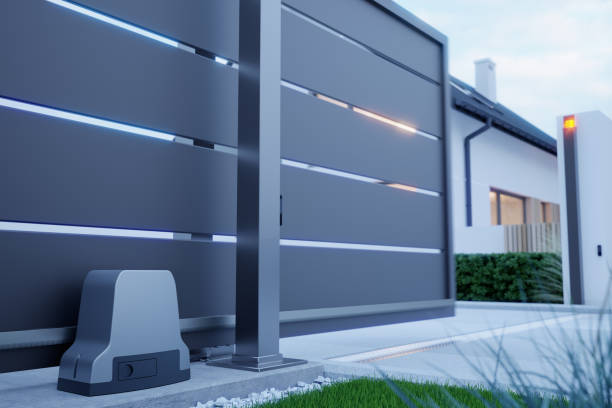
Sliding gates differ from swing gates in that they move along a straight line parallel to the fence. This allows such gates to save space in front of or behind the opening.
Most often, sliding gates are equipped with a ground track mechanism, which requires careful removal of all obstacles (stones, roots, etc.) during the installation process. This is a minus of the sliding gates as compared to the swing ones, for which the obstacle of the ground is not significant.
However, the cantilever sliding gates use a mechanism that eliminates the need for a track laying directly under the driveway. Nevertheless, for their installation, additional structures are required, as well as a strip of land next to the opening.
Another factor that must be taken into account when choosing sliding gates is the availability of space on the side where the gate will be located. The principle of the sliding gate is such that a strip of land is necessary for its rolling along it. In addition, the weight of the gate is a factor in the choice of such gates, since the gate mechanism must be able to withstand the load of the gate structure.
Posts, hinges, rollers, and drives must be selected based on the size and material of the gate.
Businesses working with these types of systems, such as BTS Industries, may deal with both gate configurations depending on driveway dimensions, available space and site conditions.
Automation can be added onto both sliding and swing gates. The swing ones typically have actuators or articulated motors, whereas sliding gates have a motor that slides the door horizontally. Sensors for safety and appropriate operating mechanisms should be installed during the process.
It is hard to say which type is better on a large scale. If there is a wide driveway with plenty of space on it, installing swing gates would probably be a good idea. Sliding ones are more likely to be appropriate when the space is limited.
Considering the slope, the room on either side of it, what vehicles should pass through it and the landscaping around the area can prevent issues in the future.