For some people, a few drinks seem to come with an annoying side effect: the hiccups. The connection can feel strangely predictable, which raises a simple question: why does alcohol cause hiccups?
Alcohol is a known cause of short-term hiccups, but not because it ‘flips a switch’ in the brain that causes hiccups to activate. Hiccups are involuntary, and involve spasmodic contractions of the diaphragm followed by closing of the vocal cords. The reflex can be made easier to trigger by the various overlapping and associated causes of alcohol related hiccups that include the combination of stomach distension, altered breathing, swallowing, upper G.I. Reflux or irritation and the conditions under which drinking occurs. For readers looking for broader health and wellness information, understanding these contributing factors can make the connection easier to recognize.
Quantity and type of alcohol are not the only relevant features. Factors such as quantity and speed of ingestion, fizzy nature of drink and having a large meal or not having an erect posture shortly after drinking might combine the conditions and include other hiccup triggers.
For most, alcoholic hiccups are transient and innocuous. This does not, however, apply to chronic hiccups. If hiccups persist for >48 hours or are disruptive to eating, sleeping or breathing, medical attention should be sought.
What Actually Happens During a Hiccup?
Hiccups are brought on by an involuntary spasm in the diaphragm-the muscle located just below your lungs that aids you in inhaling and exhaling. Under ordinary circumstances, breathing and digestion are a nicely choreographed dance. The diaphragm alternately contracts and releases to pull in and then expel air.
Hiccups are a minor disconnect in the coordination, where the diaphragm spasmes inward (while the airways between the throat and lungs close up) -resulting in the hiccups “hic”.
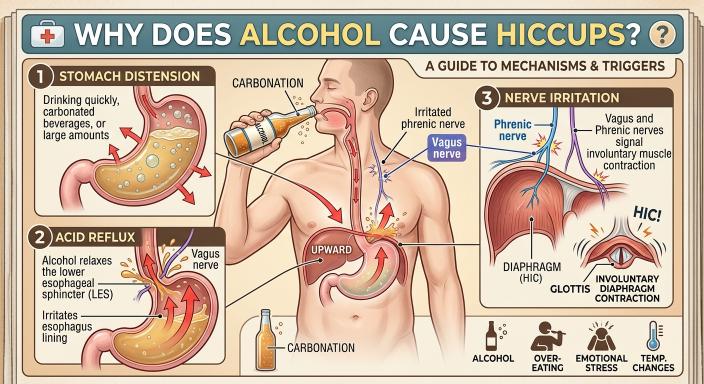
That abrupt closure causes the ‘hic’ and can stimulate vagal and phrenic nerve feedback causing involuntary contractions of the diaphragm causing repetitive contractions or hiccups. Irritation anywhere on that reflex pathway – vagal or phrenic nerve may activate hiccups. Alcohol interacts with this system.
Why Does Alcohol Cause Hiccups?
There isn’t one universally proven mechanism that explains every alcohol-related hiccup episode. Instead, alcohol can create several conditions that are known to trigger hiccups.
1. Alcohol Can Distend the Stomach
There’s the physical cause, which would be the simplest. Drinking can indeed add fluid to your stomach and distend it when you swallow down a great deal of alcohol quickly, and especially after consuming a meal that feels very filling and satisfying. Your fully distended stomach, snug up against your diaphragm, is forced to get bigger with every alcoholic drink swallowed, producing stimulation that initiates the hiccups.
Eating or drinking too much is reported by Mayo Clinic as a common short-term cause of hiccups. This would make logical sense that a particularly nocturnal evening spent out at a bar and the accompanying buffet are worse than simply a nightcap, as alcohol alone might just add to another factor for those pesky breathing disorders.
2. Drinking Quickly Can Add Another Trigger
Speed of drinking – “Fast drinkers tend to swallow more air than people who sip drinks steadily. Additionally, how quickly the stomach fills can be affected by the speed of drinking.” Swallowing air – Hiccup relief – the web-resource Mayo clinic identifies air-swallowing as one of several common causes of short term hiccups – while drinking quickly can increase the likelihood of swallowing additional air-“Many causes lead to sudden attacks of short-term hiccups including… Eating and drinking quickly”.
3. Carbonated Alcoholic Drinks Can Be a Double Trigger
When combined. This mix creates these conditions with many carbonated drinks like beer, champagne or the cocktail that mixed drinks with carbonated mixers are a great combination alcohol with carbonation is combined. With a carbonated beverage you may be a gassy in more ways than one as gas can lead to burping and has even been shown to be the cause behind short-term or hiccup from short-term or brief hiccups that can develop.
- Alcohol exposure
- Increased stomach volume
- Carbon dioxide from carbonation
- More burping or swallowed air
The result can be a greater tendency toward hiccups in someone who is already susceptible.
This does not mean carbonation is always the deciding factor. Some people get hiccups from noncarbonated alcoholic drinks as well.
4. Alcohol Can Promote Acid Reflux
Another common connection is acid reflux. Certain drinks, including alcoholic beverages, can put your lower esophageal sphincter into a relaxed state. According to Cleveland Clinic, drinking alcohol is one cause that can trigger relaxation of the valve and also create acid reflux.
This can irritate your esophagus and throat, the region of which houses nerves related to hiccup.
Hiccups may happen because of this irritation being signaled from a part of the vagus nerves as well, according to Mayo Clinic, which says acid reflux into the esophagus can contribute to nerve irritation. These reasons also help define why alcohol related hiccups often show up in combination with;
- Heartburn
- Burping
- A sour taste
- Regurgitation
- Throat irritation
- A feeling of fullness
If hiccups repeatedly occur after drinking and are accompanied by significant heartburn or regurgitation, reflux may be part of the explanation.
5. Alcohol Often Comes With Large Meals
Drinking of alcohol is often accompanied by meals, parties, and other instances that include large amounts of food.
This mix is significant because overeating is, itself, a known hiccup trigger. The Mayo Clinic lists overeating among potential causes of temporary hiccups.
Consider someone who has a big meal, drinks many beverages rapidly, drinks carbonated beverages, and then settles on a couch.
You can stop short of picking out one trigger.
The stomach is more full, you may have more gas in your stomach, your typical drinking pattern has been interrupted, and you may be more likely to have stomach reflux. Several contributing causes are at play.
This is likely a more accurate picture of a lot of drinking-related hiccups than is drinking alone.
6. Alcohol May Make Reflux More Noticeable When You Lie Down
Timing might matter.
Many reflux sufferers find their symptoms get worse when they are lying flat – and they are particularly bad if it follows a meal. GERD, also known as chronic acid reflux – “Symptoms of GERD commonly worsen with heavy alcohol use or at night or when lying down flat,” the Mayo Clinic reports.
It’s probably no accident that what could lead a familiar pattern: someone who eats/drinks a bunch of food or alcohol, lays down on the couch, and all of the sudden starts the hiccups… and it happens when drinking too.
The hiccup condition caused by laying after eating or drinking might not the laying itself – “An empty belly that becomes full of air may also contribute, especially when the condition of acid reflux is also a culprit,” according to “Hiccups Cause” . For someone who experiences this whenever they lay down after the combination, then tweaking that combination the timing may work much better than anything that attempts to cure a hiccup the cause to remedy the outcome.
7. Alcohol Can Be Part of a Larger Physiological Stress on the Body
Alcohol impacting many systems in your body, combined with potential other things that accompany heavy drinking, such as dehydration, lost sleep, vomiting, or rapid adjustments in food consumption can be the cause of a hiccup. Of course, none of these things actually causes hiccups and alcohol induced hiccup are not solely from dehydration. A better argument is that the situation that may cause excessive alcohol consumption often doesn’t occurs in a vacuum. Say that someone has some bad food, begins to have a lot of gas, and begins to bloat to a position where alcohol causes things such as hiccups or reflux symptoms – this person now have several reasons that can collectively explain away their hiccup.
8. Individual Sensitivity Matters
Not everyone gets hiccups from alcohol. While you might notice that a glass of beer gives you a fit while a friend remains unaffected after a night of drinking, this is not necessarily something medical is amiss. You may become hiccups more or less easily at any particular time, depending on what you’re drinking, how rapidly you drink it and whether you have eaten.
Paying attention to your pattern may tell more than the volume of alcohol consumed.
If you notice that hiccups seem to arise following drinks containing certain substances – whether fizz, mixers or the way you are drinking it overall – perhaps an alteration in the choice of drink may help.
9. Alcohol Is a Recognized Trigger, but Persistent Hiccups Need a Different Explanation
Ordinary hiccups can normally sort themselves out on their own.
The NHS states that most hiccups usually last for only a few minutes, but that hiccups that persist for over 48 hours may signify a problem with some medical condition or medication.
The Mayo Clinic state that any attacks lasting longer than two days and/or severe in nature so as to prevent normal eating and sleeping and breathing should be investigated.
Many causes exist for persistent hiccups, including irritation of the vagus or phrenic nerves, digestive tract complaints, metabolic problems, nervous system disorders and particular drugs and medications. Alcohol may result in continuing hiccups in specific circumstances but must not always be directly attributed to the last drink taken.
Why Beer May Give You Hiccups More Than Other Drinks
So if beer appears to be the drink more likely to set off your hiccup attack-part of that might be the carbonation.
Like wine it contains alcohol but like soda it contains carbon dioxide; in beer it gives us a compound effect combining both elements that are known to cause hiccups. Carbonation can increase stomach gas and lead to burping, and alcohol by itself is a known cause of hiccups.
But beer doesn’t get a unique award when it comes to causes of hiccups-wine, liquor or even mixed drinks can all be culprits depending on individual characteristics and drinking environment. A cocktail with a carbonated mixer could cause the same combination of events.
The more practical question therefore may not be “Which type of alcohol causes hiccups?” but rather “What am I doing differently when I consume this drink?”
Why Do Hiccups Sometimes Start After Only One Drink?
This may be because the alcohol is just one factor. By the time the person has that first drink, his/her stomach may already be packed, there may already be some acid reflux and the person may have been drinking air or some other things into their esophagus that can trigger it. He/she might then only need alcohol for a little push to get a reflex action going.
Each individual person is different too in how sensitive they are to such triggers.
A single alcoholic drink at a specific time, then, has to coincide with the hiccups; this does not mean that this particular drink caused them nor does it necessarily imply disease or overdrinking in general; more the overal pattern is more of concern, also and most important : is he/she presenting another symptom as well ?
How to Prevent Alcohol-Related Hiccups
Prevention of hiccups are of more value than treatment when they frequently occur immediately following ingestion of alcohol. The simplest and most efficient strategy involves limiting common alcohol triggers. Don’t gulp and fast-drink alcohol; limit intake if alcohol consumption occurs in conjunction with exceptionally large meals.
Be aware of the role of carbonation in beer and cocktails.
Try to limit your alcohol consumption if alcohol intake is correlated with gastroesophophageal reflux, if lying down immediately following ingestion has proven difficult, and practice delaying lying down until sometime following ingestion. Smaller meals and separation of eating time and sleep time can aid reflux relief according to Cleveland Clinic. Alcohol-use or avoidance in the case of a reflux trigger, and alcohol, generally-If either appears the culprit, eliminating both will be effective, with alcohol elimination alone being successful if alcohol is identified as the culprit.
What Can You Do When Hiccups Start?
Generally hiccups resolve without treatment for most people. The NHS website recommends drinking cold water while in the drinking position, breathing in for five to 10 seconds, pulling your knees towards your chest while tucking yourself into a forward-leaning position and eating a teaspoonful of white granulated sugar. But cautions there’s ‘little convincing evidence that these measures can alleviate all bouts of hiccups’.
One useful thing particularly when inebriated- to remember is the fact that further alcoholic beverages are an ill advisable attempt if someone has alcohol-induced hiccups.
Also refrain from any sort of risky cure methods that could result in risk of choke and inhalation/aspiration. If someone has mild, non-prolonged hiccups it is safest to just let them ride their course.
Does Drinking Water Stop Alcohol Hiccups?
While water can work for some, there’s no such thing as a surefire hiccup solution. TheNHS suggest sipping icy water can help reduce normal hiccups for some people, but warns there are no universally effective methods for tackling hiccups. This isn’t to say water should be a priority after a particularly strong few drinks however – as it’s to ease alcoholism rather than alcoholism recovery itself. Staying in a safe space until your body has had enough time to break the alcohol down is likely the safest choice.
When Should Hiccups Become a Medical Concern?
Sporadic hiccups after alcohol intake generally aren’t serious.
They warranted prompt medical evaluation if they last longer than 48 hours, occur with some frequency without clear cause and disrupt your eating, sleeping, or breathing. Intermittent hiccups can be a sign of an underlying illness involving the stomach and intestines, nervous system, metabolism or the nerves mediating hiccups. Additionally, there’s a separate problem when there has been excessive alcohol intake.
If the hiccups are accompanied by confusion, recurrent vomiting, seizures, abnormally slow or irregular breathing, difficulty staying awake or evidence of possible alcohol poisoning, then it is no longer a matter of hiccups but alcohol poisoning which is a medical emergency.
The Bigger Picture: Hiccups Are Usually About the Combination
The easiest explanation for why does alcohol cause hiccups is that alcohol is a known hiccup trigger, but the biology is more nuanced.
Alcohol makes you feel full and causes reflux. It can change the situation under which you drink and eat. Other factors such as the fizz and drinking fast along with large meals can make the situation more stimulating.
This can interact with the nerve pathways affecting the diaphragm and easily cause the reflex for the involuntarily hiccup reflex.
This is why the same people may get hiccups one night and not another. The type of beverage alone has very little to do with it.
Conclusion
So, why does alcohol cause hiccups? Alcohol is a recognized trigger for short-term hiccups, but the reaction is usually better understood as the result of several factors working together. Alcohol can accompany stomach distension, rapid drinking, swallowed air and acid reflux, while carbonated alcoholic drinks can add another established trigger.
In these instances, alcohol–related hiccups typically subside without the help of a healthcare provider. Slowing your pace of drinking, limiting consumption, and being mindful ofcarbonated Beverages and filling up on food-along with being aware of what exacerbates your reflux-might prevent future hiccup occurrences. Persistent issues, however. If you’re unable to find relief or if your hiccups last longer than 48 hours or they’re so bothersome it’s difficult to enjoy your life, these hiccups warrant medical evaluation beyond your happy hour-gone-amiss excuse.
8. FAQs
1.Why does alcohol cause hiccups but not everyone gets them?
In each individual there will be varying sensitivity to the hiccups triggers. For example, the quantity and speed that alcohol is consumed, whether the alcohol itself was carbonated, other foods that may be consumed after alcohol, reflux will all play a part in whether the alcohol triggers hiccups.
2.Does drinking beer cause more hiccups than liquor?
I can trigger me sometimes, mostly when the beer is normally also alcoholic like beer for that matter. Beer often includes also carbonization, and for some people,carbonation causes the same giggling? The problem again, giggles when something happens!
3.Can alcohol cause hiccups because of acid reflux?
Maybe. It’s possible alcohol may cause some acid reflux and make the sphincter at the bottom of your esophagus relaxed. Inflammation of your esophagus may affect the signals that regulate the hiccup reflex.
4.How long should alcohol-related hiccups last?
Normal hiccups generally do not persist long and stop on their own without any medical intervention or attention. However, If hiccups keep recurring more then forty-eight hours visit your doctor because there might be another reason that causes the prolonged hiccups.
5.Can drinking water stop hiccups after alcohol?
Drinking chilled water might offer solace for a select group of people but there is no guarantee. Cold water is mentioned as one cure with a guide on the NHS page concluding “There are several popular remedies thought to help the hiccups but none are considered to be universally successful”.
6.Does getting hiccups after drinking mean you drank too much?
Yes and No! Alcohol is known to cause hiccups, but they also occur for reasons apart from drinking large volumes. That being said drinking too much or too quickly is in itself dangerous – so please don’t try to see if anyone has drunk enough for them to have to hiccup, or if a moderate amount leads to that and a safe level of intoxication!
7.When Should I See a Doctor About Hiccups?
Consult a doctor if your hiccups persist for more than 48 hours, if they are recurring and disrupting your life or if they prevent you from eating, sleeping or breathing normally.