When a baby feels warmer than usual, it is natural to want an accurate answer quickly. Knowing how to check baby temperature can help you determine whether your baby may have a fever and give a healthcare professional useful information if the baby is unwell.
Touching a baby’s forehead may indicate that something feels unusual, but it is not a reliable indicator of fever. According to the American Academy of Pediatrics, a digital thermometer is the recommended method and the best way to take a reading is determined by the baby’s age and type of thermometer. The readings from a thermometer are not just numbers; they must be considered within the framework of the baby’s age, behavior, intake, breathing, and other symptoms. In infants less than 3 months of age, anything above a reading of 100.4F(38 C) calls for immediate medical care.n.
Why Checking a Baby’s Temperature Correctly Matters
Since they can’t say I’m hot, cold, bothered, or ill. You have to rely on visible indicators and numerical measurements. A baby’s temperature changes on a continuum depending on the amount of clothes your baby is wearing, how active your baby is, how recently they’ve fed, time of day, or method used.
In short, having a temperature above 100.4 Farenheit does not necessarily make your baby sick.
“Children’s temperatures change slightly throughout the day.” the AAP also tells us “There’s no single ‘normal’ number”. That makes method relevant. An armpit reading can help screened children for fever, but these typically provide less accurate results than forehead thermometers and some ear thermometers. If a baby is less than six months, no one recommends taking his or her temperature by ear.
A thermometer taken at the forehead can be use across all age groups following label instructions.
What you want to aim for is the most useful number you can find for your baby, given his or her age and clinical situation – not just a number.
What Type of Thermometer Should You Use?
Digital thermometers are usually best to use when taking a child’s temperature. The American Academy of Pediatrics recommends not using mercury thermometers as broken ones can be a mercury hazard.
There are various types of digital thermometers.
Digital Multi-Use Thermometer
These types of thermometer will measure temperatures in the mouth, armpit or rectum, varying depending on the particular thermometer and baby’s age. Ask your baby’s clinician or read the instructions that come with the thermometer if unsure how the best method is to take temperature in a baby thermometer. Don’t use the same thermometer in baby’s mouth if it’s meant to be used in baby’s bottom.
Forehead Thermometer
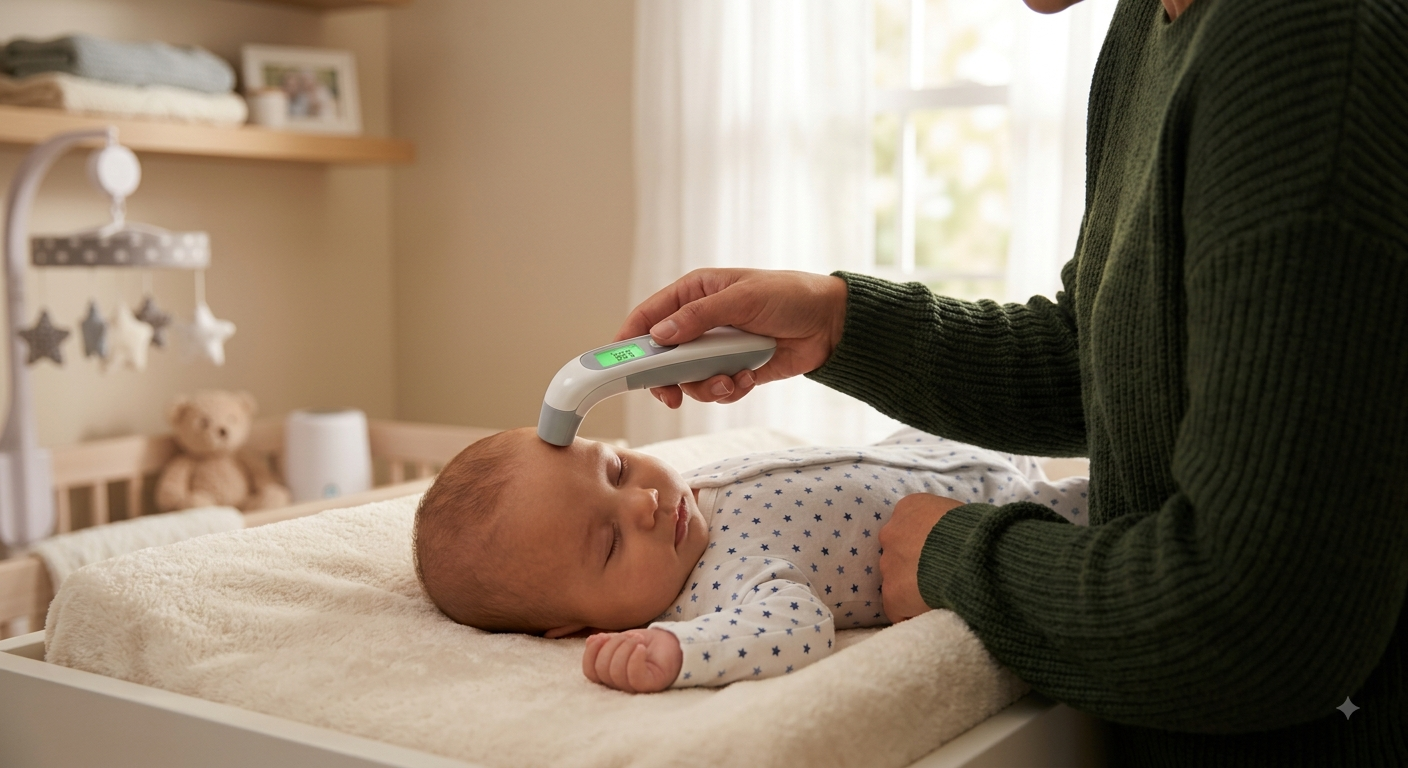
This type of thermometer, also called a temporal artery or forehead thermometer, tests temperature by detecting infrared heat. It registers heat released through forehead and the temples. Forehead thermometers can work at any age for kids, per the AAP.
Accuracy is tied to you placing it and testing it right according to maker instructions and avoiding cold or the sun.
“It is best to use care and accuracy with instructions” from the device.
Ear Thermometer
The use of ear thermometers for children or older infants might be helpful but not accurate on those less than 6 months old with their ear canals too tight. It may work on the baby for the older infants.
Armpit Thermometer
Armpit temperature taking: “This method is easy to use at any age as screening. The AAP believes, however, that armpit temperature is not as accurate as many other methods. If the armpit temperature appears to show a fever, or if the baby looks unwell, verify the temperature using an approved device or consult the baby’s doctor.”
How to Check Baby Temperature Step by Step
The steps in taking a baby’s temperature are generally dependent on the thermometer type. However, it is vital to read the manufacturer’s instructions before proceeding with the following steps.
Step 1: Pick an Appropriate Digital Thermometer
First of all, choose a digital thermometer that suits the method you have decided to use.
Make sure it is clean and works appropriately. Avoid using the strip designed for the front of the forehead as your go-to solution for measuring a baby’s temperature. The American Academy of Pediatrics highlights that forehead strips are not reliable enough to indicate a fever.
Step 2: Take Into Consideration the Environment.
The clothing, the surrounding temperature, and the activities of the baby can affect the temperature reading.
When assessing the situation, consider whether the child was overdressed or in a particularly warm area. At the same time, it is not advised to wait too long before calling for medical help for the little one if the environment seemed suitable for the baby to feel well.
Step 3: Follow the Thermometer Instructions Carefully.
Make sure the thermometer is placed as described by the manufacturer.
It is crucial to note that methods for measuring body temperature with a thermometer vary, depending on the device.
That is why the procedure for the first type of thermometer shall not be identical to the procedure for the second type.
Step 4: Wait Until You Are Notified That the
Thermometer Is Finished, and Remove It. Record the Result if Your Baby Is Sick and Has to Visit the Doctor As Well.
Step 5: Compare the Temperature with Other
Symptoms
Do not forget to assess the temperature in context.
Pay attention to whether your baby is:
- Feeding normally
- Alert and responsive
- Breathing comfortably
- Having normal wet diapers
- Sleeping differently than usual
- Unusually irritable
- Difficult to wake
- Vomiting repeatedly
- Developing a rash
These details can help a healthcare professional understand the situation.
Is 100.4°F a Fever for a Baby?
If measured at the rectum, anything 100.4 degrees Fahrenheit (38 degrees Celsius) or above usually qualifies as a fever, and the same cutoff has traditionally applied to measuring temperatures taken on the forehead and ears. That said, method matters. The AAP symptom guide, for one thing, has higher cutoff temperatures at some measurement sites than others.
(And that’s another reason why when you talk to a doctor, it’s crucial to mention how you took the temperature, not just how hot your child seemed.)
These differences are even more critical for newborns.
Fever in Babies Under 3 Months
There, above, is the situation you absolutely must take most seriously. The CDC recommends calling doctor of a child less than 3 months of age when his or her temperature reaches 100.4 F or greater. Also the AAP suggests a baby with a reading equal or higher should consult doctor immediately too.
Young infants may not display severe illness despite becoming critically ill rapidly.
A baby’s demeanor cannot be considered the only deciding factor of what constitutes significant fever. If a baby under age 3 months reads equal to or above 100.4, please see doctor. Don’t treat at home without.
How to Check Baby Temperature Without a Thermometer
The forehead can help you to discover if your baby is unusually hot to touch, but touching the forehead is not the right way to take temperature.
The AAP specifically says, “…touching the forehead is quick but not very exact.”
The temperature recorded by a digital thermometer is actually the most useful thing to have when you’re worried about a baby’s health.
If you have no thermometer and your baby seems ill-even if he is very small, there’s no reason to wait for a thermometer before contacting health care professionals when you are worried.
Is a Forehead Thermometer Accurate for a Baby?
A digital temporal artery or forehead thermometer can be used for babies, according to the AAP.
However, accuracy depends on using the device correctly.
Follow the manufacturer’s instructions for:
- Distance from the forehead
- Location of measurement
- Scanning direction
- Environmental conditions
- Cleaning
- Interpretation of readings
If the result seems inconsistent with how your baby looks or behaves, repeat the measurement according to the device instructions or contact a healthcare professional.
Is the reading of the baby’s temperature taken at the armpit accurate? Yes, an armpit temperature may serve as a good preliminary measure, but not nearly as accurate as many other options. In this vein, an armpit reading is not automatically the deciding factor for what’s best for the baby when it seems that they might not be doing too well-or for that reason when reading on their arm has them looking rather feverish. In the event that they’re debating how valid the fever really appears and for how long it must appear, it’s smart to speak to the doctor as to which method has to be considered for a given child’s age.
What About Rectal Temperature?
The most accurate readings come from an infant that is younger than 3 months of age – measuring by rectum is the preferred method for this age group. Caregivers should use only the kind of thermometer that is specially made for that reading. Both caregiver and the thermometer need special attention because an attempt is being made in a part that is more exposed, so one needs to take into account any recommendations from manufacturer and pediatrician and ensure they get all proper guidance on how to correctly perform the test with infant for accurate and comfortable reading for baby.
Caregivers need not to fear attempting this kind of test if there may be some reluctance or discomfort.
Taking it in a proper way and with guidance can help caregivers to feel much more comfortable in general as the result is generally most helpful and needed when this temperature has to be measured as an optimum way for a young infant.
What Temperature Is Too High for a Baby?
There isn’t one number for any illness that means one thing.
The age of the baby is another factor that should be considered.
In children less than 3 months, a temperature of 100.4F (38C) or higher needs immediate evaluation of the baby.
In older infants, you’d consider the temperature in conjunction with their general presentation.
Seek medical advice when fever is accompanied by concerning symptoms such as:
- Difficulty breathing
- Unusual sleepiness or difficulty waking
- Persistent vomiting
- Signs of dehydration
- A concerning rash
- Significant changes in feeding
- Seizure
- A baby who looks seriously ill
The AAP recommends urgent evaluation for certain combinations of fever and serious symptoms.
Signs That Your Baby May Have a Fever
A baby with a fever may feel warmer than usual, appear flushed, sweat more, or seem thirstier. However, symptoms can vary considerably.
Other changes might include:
- Reduced feeding
- Irritability
- Increased sleepiness
- Changes in normal activity
- Faster breathing
- Vomiting or diarrhea
- Cough or congestion
- Rash
These symptoms should not be used as a replacement for measuring the child’s temperature.
A baby may also have a fever while appearing relatively comfortable, so behavior alone isn’t enough to rule fever out.
What to Do After You Find a Fever
First, record the temperature and the method used.
For example:
Temperature: 100.6°F
Method: Forehead thermometer
Time: 9:30 p.m.
This information can provide helpful context when consulting a healthcare professional.
Keep observing your baby for changes in feeding, alertness, breathing, hydration, and other symptoms.
If the baby is under 3 months and has a temperature of 100.4°F (38°C) or higher, contact a healthcare professional promptly.
For older babies, seek medical advice based on the child’s symptoms, temperature, age, and overall condition.
Common Mistakes When Checking a Baby’s Temperature
Relying on Your Hand
A warm forehead doesn’t tell you the exact body temperature.
Using the Wrong Thermometer Method
An ear thermometer isn’t generally reliable for babies younger than 6 months.
Treating Every Temperature Reading as Identical
The measurement site affects the result. Always tell your healthcare professional where the temperature was taken.
Using Fever Strips as the Main Test
The AAP says forehead fever strips are not accurate.
Ignoring the Baby’s Age
A temperature that might be monitored differently in an older infant can require urgent evaluation in a baby under 3 months.
Focusing Only on the Number
A baby’s behavior, breathing, hydration, feeding, and other symptoms are important parts of the assessment.
How to Keep the Thermometer Clean
Clean thermometer as per directions with it. Use the manufacturer’s instructions as recommended by the AAP. If you use a rectal thermometer, make sure it has specific identifying marks so that it’s never used for something else in the house. 3. When using a thermometer by more than one family member, clean it diligently.
When to Contact a Doctor
Call your healthcare provider right away if your baby is younger than 3 months and has a temperature above 100.4F (38C). Anyone. Call immediately if a baby has a fever combined with serious signs like a fever and shallow breathing or trouble getting air, unusual sleepiness or lethargy, not responding to you, constant vomiting which means you can’t get liquids to stay down, or other signs that suggest your baby is very sick. It’s also okay to call the child’s health care provider if your instincts say something isn’t right and the thermometer says so.
Final Thoughts on How to Check Baby Temperature
Learning how to check baby temperature is an important part of caring for an infant, but the Taking a baby’s temperature is more complicated than just touching a thermometer to the skin and noting a number. A digital thermometer is obviously better than just feeling the forehead; however, what is appropriate depends on the age of your baby and the type of thermometer you have. You can use forehead thermometers for babies.
An underarm temperature may be helpful for screening, but rectal temperatures are the most accurate readings for infants.
Generally ear thermometers are unreliable for babies under six months of age. The main thing to note is that for babies under three months old, a temperature over 100.4F(38C) means that you should see a physician very quickly. Make a note of the reading and what method you used, note any other factors of your baby’s condition, and call your physician if you have any doubts.
FAQs About Checking Baby Temperature
1. What is the best way to check a baby’s temperature?
It can depend on the baby’s age, plus the thermometer that you have. The best place to check your baby’s temperature, as recommended by the AAP, is the rectum, but a digital thermometer on the forehead is also an option for checking a baby’s temperature. Just follow the instructions that come with the thermometer you have and what your doctor recommends.
2. Is 100.4 a fever in a baby?
Yes, your baby has a fever if their temperature is 100.4 degrees Fahrenheit or 38 degrees Celsius or higher, measured rectally. A baby with a fever of 100.4 degrees Fahrenheit or higher requires immediate medical attention, especially if they’re under 3 months old.
3. Can I check my baby’s temperature by touching their forehead?
You can use their forehead to check whether they are hot or cold, but it will not be an accurate temperature measurement. Instead, you can use a digital thermometer for taking your baby’s temperature more accurately.
4. Can I use an ear thermometer for a newborn?
An ear thermometer is not recommended for newborns as it is considered ineffective for measuring temperature in children under 6 months of age due to the small size of their ear canals. You must take another mode of temperature measurement as recommended by your healthcare provider.
Can an armpit temperature provide an accurate reading for babies?
An armpit temperature can be used to screen for temperature, but it is not considered as accurate as other methods of measuring temperature. If you’re worried about the temperature, or your baby looks or feels unwell, you should always consult a medical professional.
6. What should I do if my baby is under 3 months and has a fever?
If your baby is under three months old and has a temperature of 100.4°F (38°C) or above, contact a healthcare professional promptly.
7. My baby feels feverish, but the thermometer is not showing a fever ?
If you think that your child may be feverish, you should take their temperature again following the instruction manual for your thermometer and pay close attention to their symptoms. If you’re still not sure about their temperature, or your baby looks or feels unwell, you should seek advice from a medical professional.